Swift · UIKit · SwiftUI
Practice iOS interviews with questions worth your time
Work through realistic prompts on concurrency, UIKit, SwiftUI, and how systems fit together — written for engineers preparing for phone screens, loops, and senior-level conversations.
Questions & answers
Get the complete explanation
How do you implement MVVM in SwiftUI?
Contrast Combine-era ObservableObject MVVM with iOS 17+ @Observable MVVM, keeping the same Provider → ViewModel → View boundaries, DI, and testability rules
How do you make shared mutable state thread-safe in Swift?
Start with the race condition, then compare locks, semaphores, queues, barriers, and actors for protecting shared mutable state in real Swift code
Prepare by topic
Swift
15 questions · Ownership, protocols, generics, concurrency, and language fundamentals
Concurrency
8 questions · Actors, async/await, isolation, Sendable, and data-race reasoning
UIKit
4 questions · View lifecycle, rendering, diffable data sources, and UIKit architecture
SwiftUI
4 questions · State, identity, data flow, and compositional UI design
Question banks
Know what they'll ask
All levels2,430 questions
The Complete iOS Interview Question Bank
For Beginner, Intermediate & Experienced iOS Developers
The full set of frequently asked iOS interview prompts — Swift through SwiftUI, architecture, concurrency, coding interviews, and AI-era.
$19 · Preview questions →
Complete set
2,430
questions
All levels267 questions
Essential iOS Interview Questions
Free practice across Swift, architecture, concurrency, storage, networking, Combine, SwiftUI, and testing.
0 / 267 answered
Beginner100 questions
100 Must-Know Questions for Your First iOS Interview
Foundational practice for first iOS interviews. Swift basics through networking and testing.
$4 · Preview questions →
Experienced100 questions
100 Advanced Questions for Senior iOS Engineers
Advanced questions for senior and lead interviews. Architecture, performance, and technical decisions.
$4 · Preview questions →
Mock interviews
Practise with an interviewer
Turn preparation into interview practice. Test yourself in a realistic setting, get direct feedback, and identify weak areas before the real loop.
- Craft precise answers under live pressure
- Learn what interviewers actually listen for
- Overcome in-the-moment answering anxiety


Books
Go beyond interview questions
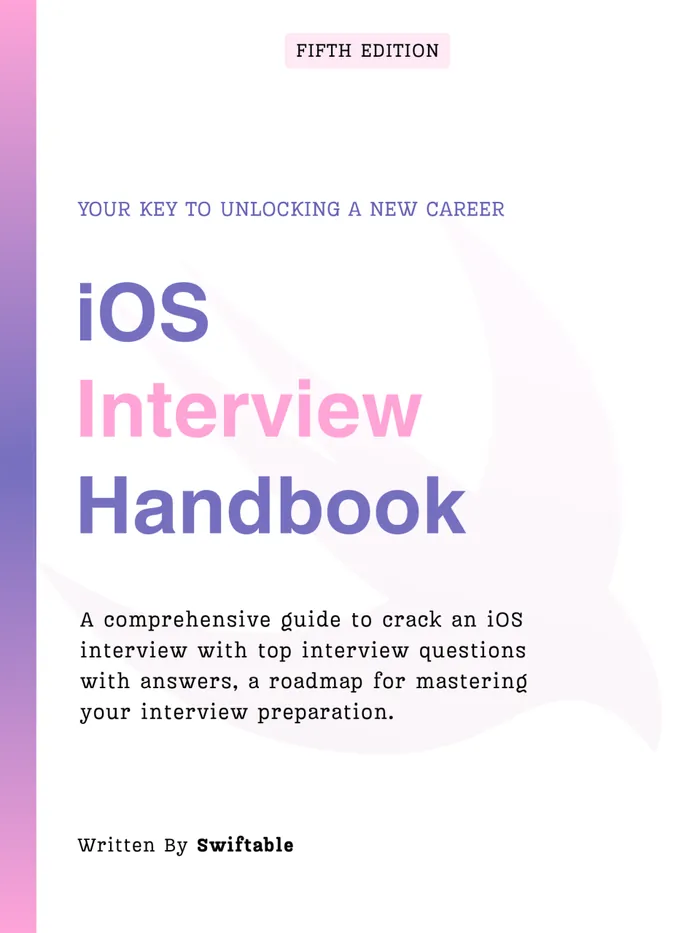
iOS Interview Handbook
A practical prep companion: 340+ curated questions with answers and examples, plus a 45-day roadmap across iOS, mobile system design, and DSA.
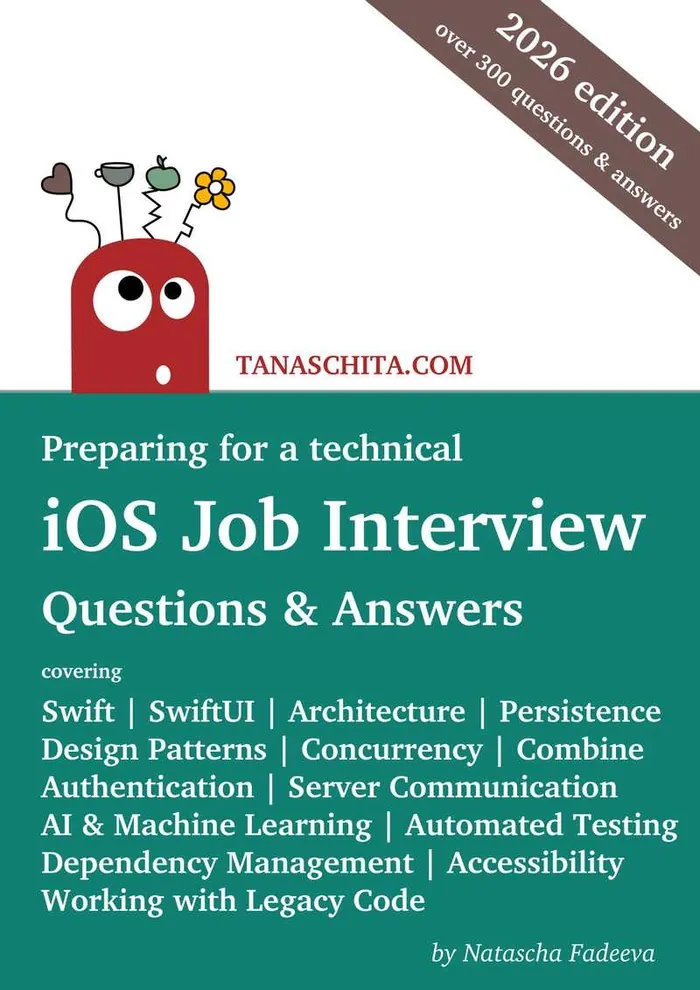
Preparing for a technical iOS job interview
300+ iOS interview questions with answers, grouped by topic so you can self-test chapter by chapter before you look at a single answer.
Cracking the iOS Interview — Platform Round
Senior-level platform interview prep that focuses on how strong iOS engineers think, reason, and handle follow-ups — not API memorization.
Watch & read